

19
2026
-
10
How to Operate UAVs in Rain, Dust, Heat, and Chemical Exposure
A practical guide to operating UAVs in rain, dust, heat, and chemical exposure, covering environmental limits, inspections, monitoring, cleaning, maintenance, recovery rules, and validation.


Author:
How to Operate UAVs in Rain, Dust, Heat, and Chemical Exposure.
Operating a UAV in rain, dust, heat, or chemical exposure requires more than choosing a sealed component. The complete aircraft, payload, battery, wiring, propulsion system, flight controller, data link, and ground equipment must be managed within a defined environmental operating envelope. A component-level protection rating does not automatically make the complete drone safe to fly in every weather or chemical condition.
The correct approach is to classify the exposure, set a clear go/no-go limit, inspect the aircraft before launch, monitor changes during the mission, and clean and document the system immediately afterward. This is especially important for agricultural spraying, inspection near dust or construction, coastal work, emergency response, and other operations where moisture, particles, heat, or chemicals can enter the aircraft's mechanical and electrical interfaces.
This guide explains how to operate UAVs in rain, dust, heat, and chemical exposure. It focuses on operational controls, maintenance, contamination management, and validation. It does not replace the aircraft manufacturer's instructions, local aviation rules, chemical-label requirements, or a product-specific environmental test report.
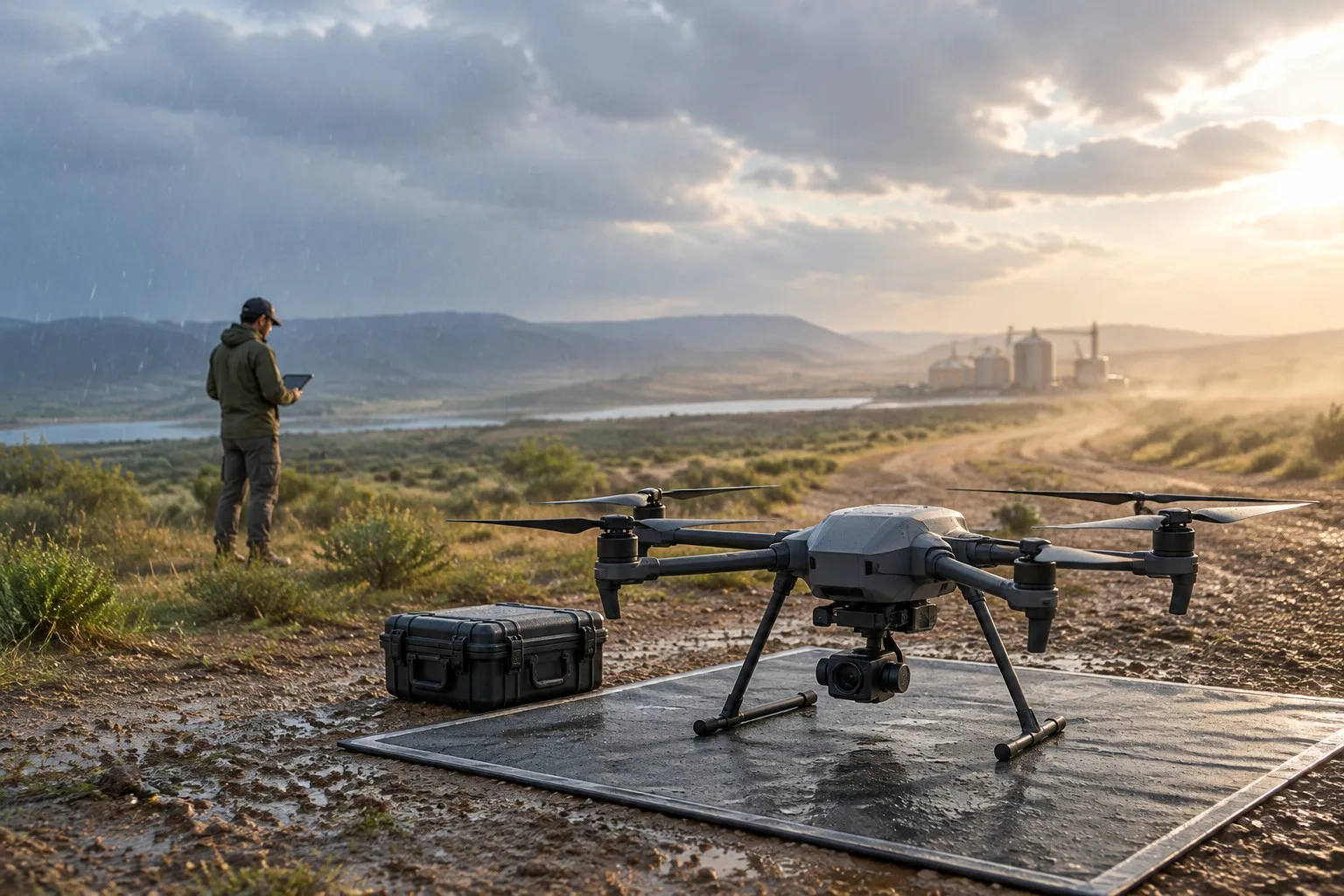
1. Define the Environmental Operating Envelope
Before a mission begins, write down the conditions in which the UAV is allowed to operate and the conditions that require postponement or immediate recovery. The environmental envelope should be specific to the aircraft configuration, not copied from a single motor, servo, battery, or enclosure specification.
Record the following inputs:
- Air temperature and expected temperature change during the mission;
- Rain, mist, spray, humidity, and condensation risk;
- Dust type, particle size, concentration, and likely entry paths;
- Chemical identity, concentration, temperature, and contact duration;
- Wind, turbulence, and downwash interaction with spray or dust;
- Ground conditions at the launch and recovery area;
- Battery storage and operating temperature;
- Payload, tank, pump, nozzle, camera, or release-mechanism exposure;
- Cleaning method and available decontamination equipment;
- Maximum mission duration before inspection or service;
- Recovery location if the environment deteriorates.
The phrase “waterproof drone” is not a complete operating specification. It does not identify the allowable rainfall rate, immersion condition, flight duration, chemical compatibility, connector protection, or the behavior of the aircraft while moving through contaminated air. Similarly, “industrial-grade” does not establish a tested temperature range or dust-ingress limit.
Use an environmental risk register for each platform. List every subsystem that can be affected and assign a control measure. For example, rain may affect the flight controller enclosure, camera window, connectors, battery bay, and landing surface. Dust may affect motor bearings, cooling paths, gimbal joints, and connector seals. Chemical exposure may affect hoses, pumps, seals, coatings, wiring jackets, and actuators.
Set three operational states:
- Approved: conditions are within the tested and documented envelope.
- Restricted: the mission may proceed only with additional controls, shorter duration, or increased inspection.
- No-go: launch or continued flight is not permitted under the current conditions.
The exact thresholds should come from the aircraft manufacturer, component suppliers, local rules, and the project's own validation tests. If a threshold is unknown, treat it as an open verification item rather than assuming the aircraft is suitable.
2. Operating UAVs in Rain and High Humidity
Rain creates several separate risks: direct water entry, surface wetting, reduced visibility, changing aircraft weight, electrical leakage, connector corrosion, and contamination after landing. Light rain may be very different from driving rain, spray from a vehicle, or repeated wetting during multiple missions.
Before a wet-weather mission, inspect enclosure joints, access covers, cable exits, connectors, antenna mounts, payload windows, battery compartments, and drain paths. Confirm that covers are seated and that no seal is pinched, damaged, contaminated, or missing. Check the aircraft for trapped water from an earlier flight and allow wet components to dry before connecting power.
High humidity also creates condensation risk. A cold battery or airframe moved into warm humid air can develop moisture inside an enclosure even when the aircraft has not flown in rain. Avoid sealing wet equipment inside a case. Use a controlled drying and storage process, and inspect internal areas where practical before the next mission.
During flight, rain can affect optical payloads, radio performance, propulsion efficiency, and operator visibility. Water on a lens or protective window can reduce image quality even if the aircraft remains controllable. Heavy wetting can also change the aircraft's mass and aerodynamic behavior. The operator should have a defined recovery trigger based on worsening rain, reduced visibility, unstable telemetry, abnormal power readings, or payload degradation.
After landing, do not immediately place a wet aircraft into a closed transport case. Isolate the battery according to the manufacturer's procedure, remove standing water with an approved method, and inspect cable entries, connectors, motors, actuators, camera mounts, and landing structures. Do not apply compressed air in a way that drives water or contamination deeper into seals, bearings, or connectors.
A component described as IP67 or waterproof must be interpreted within its published test conditions. The official FEIYIDA agricultural-drone content discusses IP67 waterproof servos as a way to address moisture and chemical exposure in specific actuator applications. That does not establish an IP67 rating for the complete UAV or prove that the full aircraft can operate indefinitely in rain. Treat component protection and aircraft-level weather approval as separate questions.
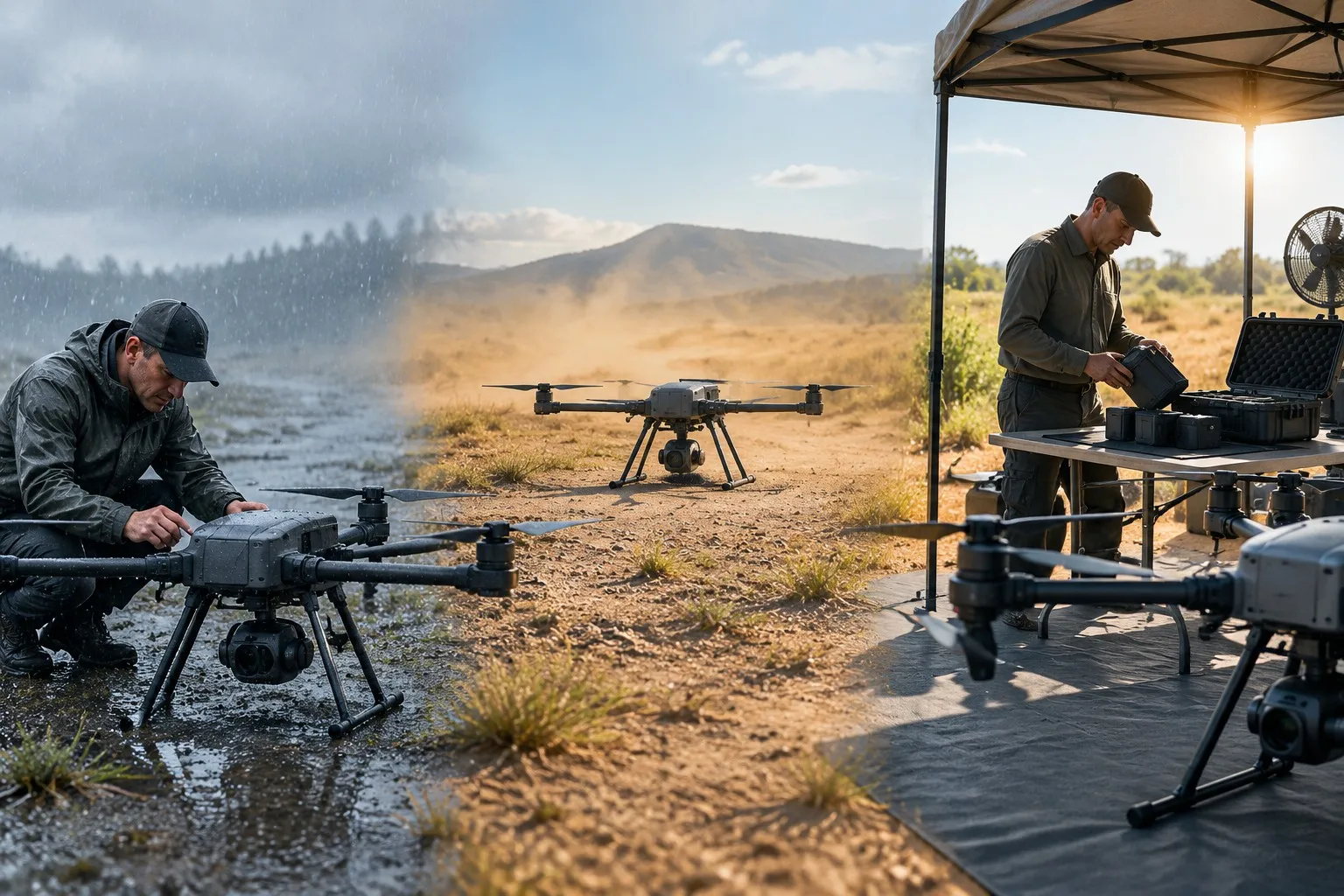
3. Managing Dust, Sand, and Fine Particles
Dust exposure is not limited to desert operations. Agricultural fields, construction areas, unpaved roads, dry vegetation, mineral handling, and landing zones can all generate particles that enter motors, cooling paths, gimbal mechanisms, connectors, and moving joints.
Start with a particle-entry map. Identify openings around motor bearings, cooling vents, battery bays, cable glands, payload mounts, landing gear, actuator shafts, and removable covers. Determine which openings are intentional and which are potential failure paths. A cover that prevents large debris may not stop fine dust. A filter that reduces dust entry may also restrict airflow and increase heat.
Dust affects UAVs in several ways:
- Abrasion at bearings, shafts, gears, and seals;
- Reduced cooling performance when vents or heat sinks become blocked;
- Increased friction in gimbal, servo, or payload mechanisms;
- Conductive or hygroscopic contamination on electrical surfaces;
- Connector wear and intermittent signal behavior;
- Reduced camera or sensor visibility;
- Battery and charger contamination;
- Difficult inspection when dust hides cracks or leaks.
Avoid launching directly into a visible dust cloud unless the aircraft and mission have been specifically validated for that exposure. Downwash can pull dust into the propulsion system and may recirculate particles around the aircraft. When choosing a launch site, consider wind direction, loose soil, vehicle movement, crop residue, and the effect of rotor wash on the ground surface.
After a dusty mission, remove loose particles before opening sensitive compartments. Use the cleaning method approved for the aircraft and components. Inspect motor bearings, propeller hubs, cooling openings, actuator joints, cable glands, and camera windows. Do not assume that a motor that still turns freely is unaffected; fine particles may shorten bearing life or change temperature behavior over time.
Record the operating environment and the cleaning action. If the same aircraft repeatedly operates in dusty conditions, compare motor temperature, current, vibration, actuator current, and maintenance findings over time. A trend can reveal gradual contamination before it becomes a flight failure.
4. Operating in High Heat and Strong Sunlight
High temperature affects batteries, motors, ESCs, flight controllers, cameras, radios, actuators, seals, adhesives, and structural materials. Strong sunlight can also heat a stationary aircraft far above the surrounding air temperature, especially when it is stored in a closed vehicle or placed on dark ground.
Separate the temperatures that matter:
- Ambient air temperature;
- Battery temperature before launch;
- Battery temperature during the mission;
- Motor and ESC temperature under load;
- Flight-controller and computer temperature inside the enclosure;
- Camera and payload temperature;
- Ground-station and radio temperature;
- Surface temperature after sun exposure;
- Storage temperature in transport cases or vehicles.
Before launch, move the aircraft and batteries into a shaded, ventilated preparation area where possible. Check battery condition, swelling, leakage, connector condition, and temperature according to the battery supplier's procedure. Avoid charging or storing batteries in direct sunlight or in a hot closed vehicle.
Heat management is a system problem. A high-current propulsion system may warm the battery, ESCs, motors, and power wiring at the same time. A sealed avionics compartment may protect against dust and water but trap heat. A camera or onboard computer may generate additional heat that changes the internal compartment temperature even when the aircraft is moving.
Use shorter initial missions when operating near a thermal limit. Monitor battery voltage, current, temperature, flight-controller status, ESC or motor warnings, payload behavior, and communication quality. Define a recovery threshold before takeoff. Do not wait for a thermal alarm if the aircraft is already showing abnormal current, repeated warnings, control degradation, or a rapid increase in temperature.
After landing, allow hot components to cool in a clean, shaded area. Do not close a hot aircraft inside a sealed case. Inspect for softened adhesives, deformed covers, discolored connectors, unusual odor, battery swelling, or signs of thermal stress. Record the mission load and environmental temperature so future missions can be compared.
The official FEIYIDA site publishes specific product data for individual servos and other components, but those values should not be generalized into an aircraft-wide high-temperature rating. Confirm the environmental limits for each subsystem and validate the assembled aircraft under the intended duty cycle.
5. Managing Chemical Exposure in Agricultural and Industrial Missions
Chemical exposure requires a substance-specific risk assessment. Fertilizers, pesticides, cleaning agents, salt water, fuels, solvents, and industrial chemicals can affect materials differently. A product described as water-resistant may not be compatible with a particular chemical, concentration, temperature, or repeated exposure pattern.
Before an agricultural or industrial mission, record the chemical name, mixture, concentration, temperature, application method, expected overspray, contact duration, and required cleaning procedure. Check the chemical label and the manufacturer's safety documentation. Confirm material compatibility for tanks, hoses, pumps, seals, connectors, cable jackets, actuator housings, coatings, and payload windows.
Protective planning should cover both the aircraft and the people operating it. Establish procedures for chemical handling, personal protective equipment, spill response, battery isolation, contaminated-area access, transport, and waste water or residue. An aircraft should not be brought into a clean maintenance area until the decontamination procedure is complete.
Chemical residue can remain even when the aircraft appears dry. It may attract moisture, promote corrosion, change seal behavior, contaminate connectors, or damage optical surfaces. Downwash can also distribute spray onto parts of the aircraft that were not obvious from a static inspection. Folding arms, actuator shafts, motor housings, landing gear, battery covers, and cable entries deserve special attention.
After the mission, follow a controlled sequence:
- Move the aircraft to the designated decontamination area.
- Isolate batteries and sensitive equipment according to the manufacturer's procedure.
- Remove visible residue using the approved cleaning agent and method.
- Prevent contaminated liquid from entering electronics, bearings, or open connectors.
- Dry the aircraft completely before storage or recharge.
- Inspect seals, cables, housings, motors, actuators, pumps, nozzles, and payloads.
- Record the chemical, exposure time, cleaning method, and observed damage.
The official FEIYIDA agricultural-drone article links chemical corrosion and humidity to the need for protected actuator solutions, including an IP67 waterproof servo reference. That is useful as a component-selection consideration, but it should not be interpreted as proof that an entire spray drone is chemically sealed. The complete spraying system still needs material compatibility, cleaning, inspection, and field validation.
6. Create a Pre-Flight, In-Flight, and Post-Flight Procedure
Environmental reliability improves when operators follow the same sequence on every mission. A checklist should be short enough to use in the field but specific enough to catch the failure modes associated with the day's conditions.
Pre-flight checks
Confirm the weather and worksite conditions against the approved, restricted, or no-go state. Inspect the airframe for cracks, loose covers, contaminated seals, blocked vents, damaged cable glands, and residue from the previous mission. Check propellers, motors, ESCs, actuators, payload mounts, battery compartments, antennas, and landing equipment.
Verify the battery temperature and condition, payload installation, tank or release mechanism, camera window, data link, telemetry, flight-controller warnings, and ground-station readiness. For chemical missions, confirm the correct liquid, mixing record, nozzle or pump condition, and decontamination equipment. For dusty sites, check that the launch area will not generate an avoidable particle cloud.
In-flight checks
Monitor more than position and battery percentage. Watch voltage, current, temperature, control response, vibration indications, communication status, payload image quality, camera or gimbal behavior, and warning messages. The operator should know which symptoms require a shorter route, payload shutdown, immediate return, or landing at the nearest safe location.
Avoid changing the mission plan casually when environmental conditions are worsening. A route that was acceptable during a dry launch may become unsuitable after rain, spray drift, rising heat, or a change in wind direction.
Post-flight checks
Record the conditions and the actual mission duration. Inspect for water, dust, chemical residue, heat damage, abnormal odor, loose hardware, connector discoloration, bearing noise, actuator stiffness, and payload contamination. Clean the aircraft according to the approved procedure, separate wet or contaminated equipment, and do not return it to service until the required inspection is complete.
A post-flight record should include the aircraft identification, battery identification, weather, chemical or dust exposure, warnings, cleaning action, defects, parts replaced, and release decision. This turns field experience into a maintenance history instead of relying on memory.
7. Set Clear Stop, Recovery, and Maintenance Rules
Environmental operations need predefined stop rules. Without them, teams may continue a mission because the aircraft is still technically flying even though the margin has become unacceptable.
Stop or recover when any of the following occurs, unless the aircraft's approved procedure defines a safer alternative:
- Rain exceeds the documented limit or visibility deteriorates;
- Water is visible inside an enclosure or on a sensitive connector;
- Dust blocks cooling paths or makes sensor output unreliable;
- Chemical spray reaches an area not approved for exposure;
- Battery, motor, ESC, avionics, or payload temperature rises abnormally;
- Communication, telemetry, or control quality degrades;
- A seal, cover, cable gland, or connector is damaged;
- The aircraft shows repeated warnings or unexplained current changes;
- The launch or recovery area becomes unsafe;
- The operator cannot complete the required recovery procedure.
The recovery plan should identify an alternate landing area, safe payload state, battery reserve, communication path, and people responsible for the decision. For spraying or delivery missions, define how to stop the pump, secure the payload, and prevent unintended release. For inspection missions, define how to preserve data and return without exposing the aircraft to a worsening environment.
Maintenance rules should be based on exposure and duty cycle, not only calendar time. An aircraft used once in clean, dry conditions may require a different inspection schedule from an aircraft used daily in spray, dust, salt, or high heat. Escalate an inspection after a hard landing, water event, chemical spill, overheating warning, abnormal vibration, or unexplained communication problem.
Use condition-based records where possible. Compare temperature, current, vibration, actuator response, battery performance, and defect history with earlier missions. A trend toward higher temperature, slower actuator response, increased current, or more frequent warnings can justify preventive service before a failure occurs.
8. Validate the Complete Aircraft Before Repeated Field Use
A component test is not the same as an aircraft environmental qualification. Before repeated operations, validate the actual airframe, payload, battery, software, wiring, cleaning process, and operator procedure under representative conditions.
Begin with a documentation review. Confirm the published limits and test conditions for the aircraft and each exposed component. Identify gaps such as unknown chemical compatibility, missing temperature limits, unverified connector protection, or unclear cleaning instructions. Do not fill a gap with a marketing term or an assumption based on another component.
Proceed through staged testing:
- Dry bench test: Verify power, sensors, motors, actuators, payload, data link, and logs without environmental exposure.
- Cleaning and inspection trial: Use the planned cleaning tools and confirm that the procedure does not force contamination into sensitive areas.
- Controlled moisture or particle test: Only within an approved test plan, expose representative equipment to the intended condition and inspect afterward.
- Loaded ground test: Run motors, pumps, cameras, radios, and actuators under the expected load while monitoring temperature and current.
- Controlled flight test: Use a conservative mission to confirm control, telemetry, payload, battery, and recovery behavior.
- Representative mission test: Repeat with the real route, chemical or dust exposure, duration, operator workflow, and post-flight service procedure.
- Repeatability test: Confirm that performance and inspection findings remain acceptable across repeated missions, not just the first trial.
Acceptance criteria should cover aircraft control, sensor health, communication, power, temperature, payload function, contamination, cleaning effectiveness, and visible or measured damage. The final record should identify the tested configuration and conditions so that a future component substitution or firmware update triggers a review.
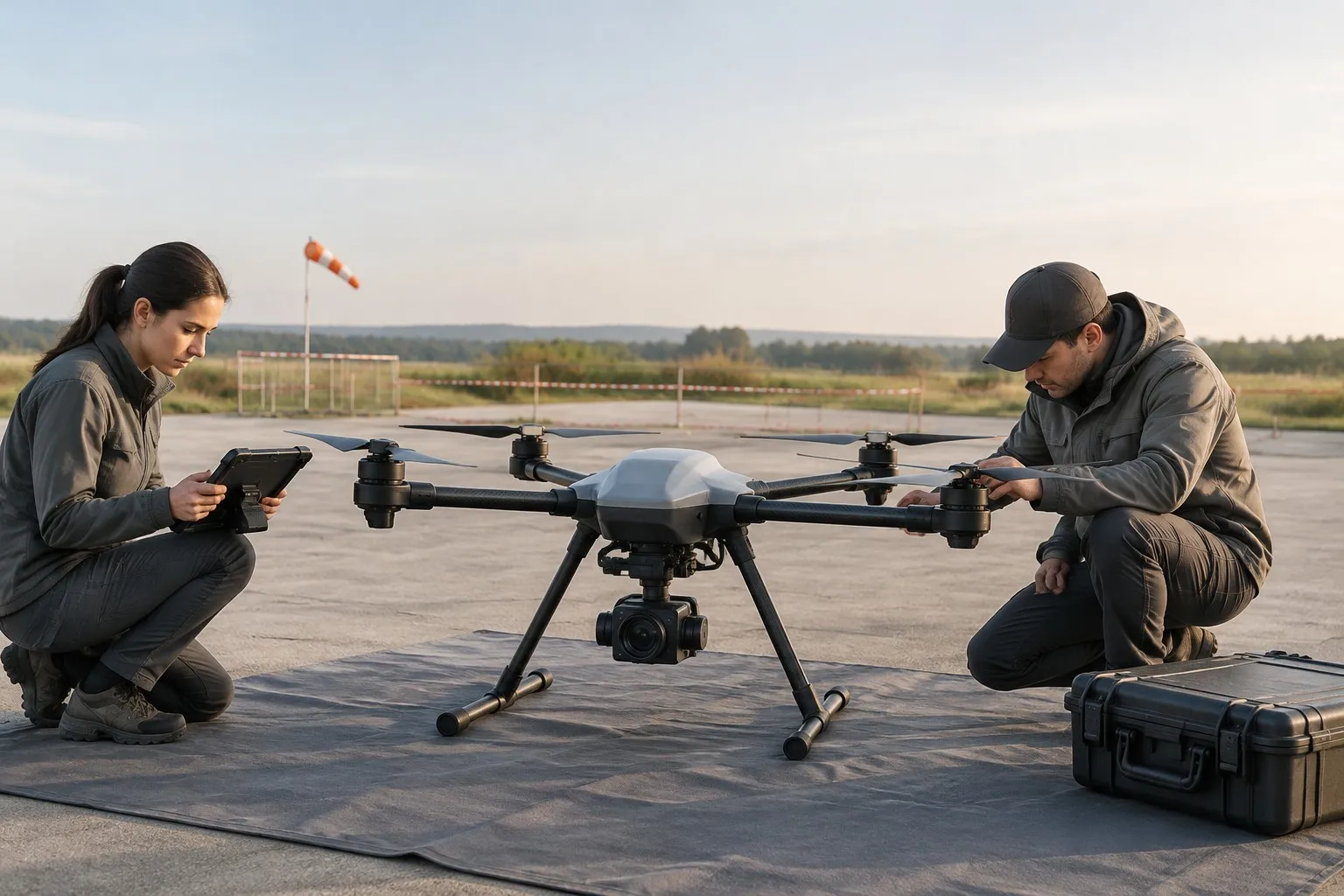
Conclusion: Operate Within Evidence, Not Assumptions
Rain, dust, heat, and chemical exposure should be treated as mission variables that affect the entire UAV system. The safest operating method is to define an environmental envelope, classify conditions as approved, restricted, or no-go, inspect the aircraft before flight, monitor key indicators during the mission, and clean and document the system immediately afterward.
A protected servo can improve the reliability of a particular actuator. It cannot by itself certify the airframe, battery, camera, flight controller, data link, connectors, or chemical-handling procedure. Likewise, a dry bench test cannot prove that the aircraft is ready for repeated agricultural spraying, dusty construction work, hot-weather operations, or wet-weather inspection.
FEIYIDA's published technical content addresses harsh agricultural conditions, chemical corrosion, humidity, protected actuators, and water-ingress validation for specific servo applications. Use those references as component-level inputs, then confirm the limits of the complete UAV configuration before field deployment.
Planning UAV operations in a harsh environment? Contact FEIYIDA with the aircraft type, payload, battery system, expected weather, dust or chemical exposure, mission duration, and cleaning procedure for a configuration review.
Frequently Asked Questions
Can a UAV fly in light rain?
Only if the complete aircraft and mission have a documented operating allowance for the expected rain and the operator follows the manufacturer's restrictions. A waterproof or IP-rated component does not automatically establish a rain approval for the complete UAV.
Does an IP67 servo make an agricultural drone waterproof?
No. It provides a product-level protection reference for that servo under its specified conditions. The complete agricultural drone still requires validation for its airframe, battery bay, flight controller, data link, motors, payload, wiring, pump, hoses, and cleaning process.
How should a UAV be cleaned after pesticide or fertilizer exposure?
Use the aircraft and chemical manufacturers' approved cleaning procedures. Isolate batteries and sensitive equipment, remove residue in a designated area, prevent contaminated liquid from entering electronics or bearings, dry the aircraft completely, inspect exposed parts, and record the chemical and cleaning action before returning the UAV to service.
What is the main risk of operating a UAV in dust?
Dust can enter bearings, cooling paths, connectors, actuators, and payload mechanisms. It can increase friction, abrasion, heat, and intermittent electrical faults. Launch-site selection, exposure control, post-flight cleaning, and condition-based inspection are all necessary.
How does heat affect UAV operation?
Heat can reduce battery margin, raise motor and ESC temperature, increase avionics-compartment temperature, affect payload performance, and accelerate material or seal aging. Monitor actual temperatures and current under load, provide shade and ventilation, and define recovery limits before takeoff.
What should be recorded after a harsh-environment mission?
Record aircraft and battery identification, weather, temperature, rain or dust condition, chemical exposure, mission duration, warnings, temperature and current observations, cleaning method, defects, replacement parts, and the decision to release or hold the aircraft.
When should a UAV mission be stopped?
Stop or recover when conditions exceed the documented limit, water or chemical residue reaches an unapproved area, dust blocks cooling or sensors, temperatures rise abnormally, communication quality degrades, a seal or connector is damaged, or the operator cannot complete the recovery procedure safely.
Confirmed Internal Links
The Agricultural Drone Power System Optimization article supports the chemical-corrosion, humidity, protected-actuator, and agricultural-use context. The High-Frequency Underwater Servo Water-Ingress Guide supports the distinction between a component-level sealing reference and a complete aircraft environmental qualification.
Use the Multi-Rotors product category, XQ-POWER SERVO product category, Battery & Charger product category, Flight Controller product category, Gimbal Camera product category, and Video & Data Link product category for system-level navigation. The FYD-D4010L Agricultural Sprayer Drone Specifications page can support agricultural mission context.
Article Schema Notes
Use Article schema only after the final author, publication date, modified date, featured image, and canonical URL are confirmed. The structured data should match the visible article exactly, including its final headline, author identity, dates, image, and canonical URL. Do not add a whole-aircraft waterproof, dustproof, heat-rating, chemical-compatibility, product-rating, or certification claim unless that information is visible and documented for the page.
If the FAQ section remains visible on the published page, an FAQ schema can be added for the questions above, with answers matching the visible text. Do not add Product, Review, AggregateRating, or Offer schema to this editorial article unless the page visibly contains the required information.
Keywords:
Related news
How to Select a UAV Flight Controller for Multirotor and VTOL Applications
How to Verify a Servo Mechanical Interface Before Installation
FYD-D4010L Agricultural Sprayer Drone Specifications: How to Read the Product Page
Industrial Servo OEM/ODM Specification Checklist for UAV, Robotics and Automation
How to Specify a UAV Mission-Payload Deployment Actuator
UAV Multi-Node Actuator Maintenance and Troubleshooting Guide
Consult Immediately
If you are interested in our products, please leave your email and we will contact you as soon as possible. Thank you!



Company Address: 1 Bldg,Tonghe Industrial park,N26.Fuping Road,Longgang District Shenzhen City ,Guangdong Province,China.


© 2024~ Shenzhen XQ-POWER Technology Co., LTD. All rights reserved.