

21
2026
-
10
Servo Heat Dissipation: How to Review Thermal Risk Before Continuous-Load Integration
A practical, model-specific method for reviewing servo thermal risk under acceleration, reversal, holding and enclosed mounting. The article explains duty-cycle definition, heat paths, voltage/current and temperature measurements, staged validation, FAQ, official sources and fact boundaries without assigning a universal continuous-duty rating.


Author:
Servo Heat Dissipation: How to Review Thermal Risk Before Continuous-Load Integration
Direct answer: thermal risk is a load-cycle problem, not a single torque number.
A servo can be thermally suitable only when its actual load cycle, mounting arrangement, ambient environment and operating voltage are reviewed together. Separate peak motion from continuous holding: acceleration may create a high current pulse, while a smaller holding torque can create heat for much longer.
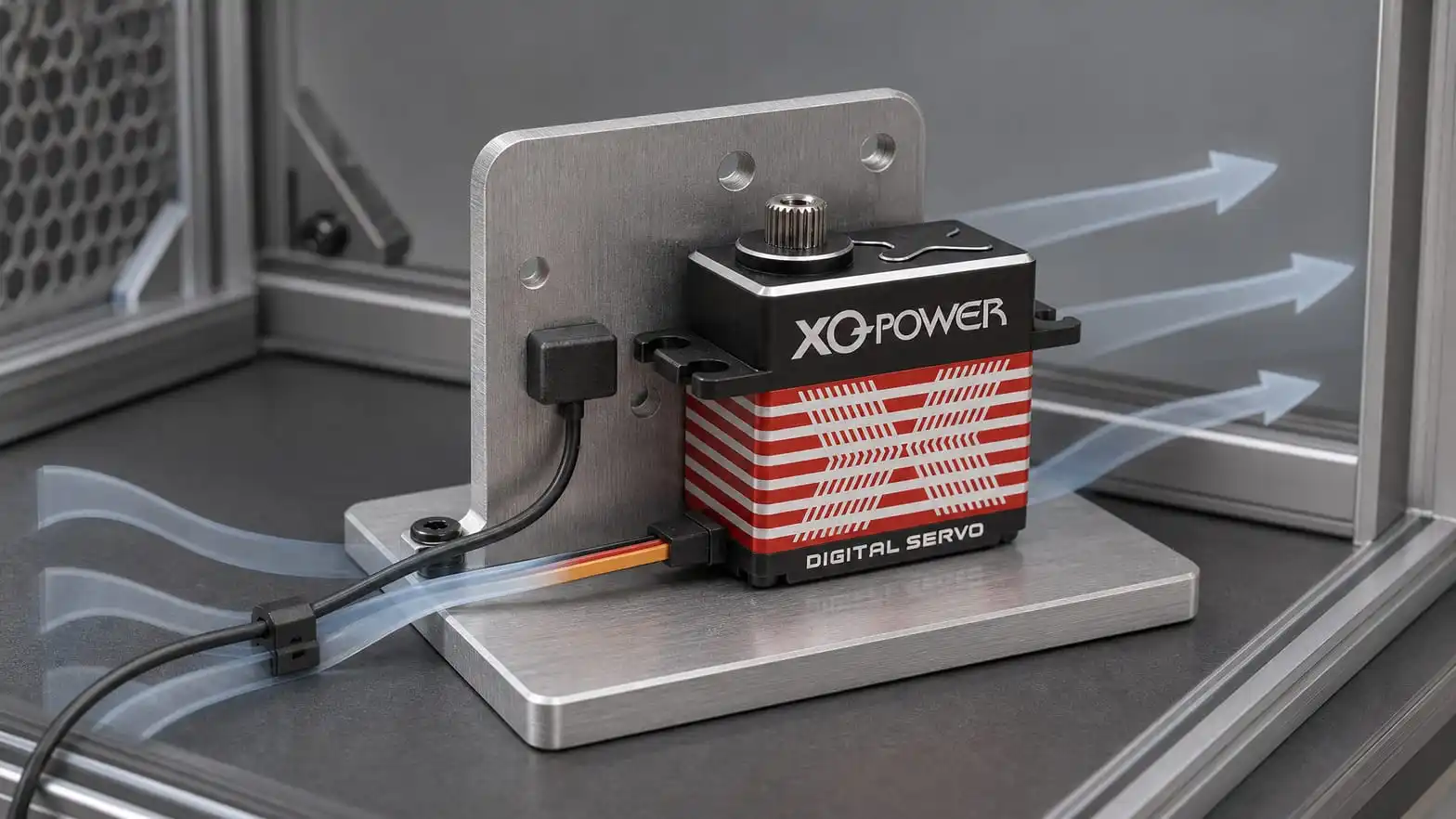
What a practical thermal review should answer
- What torque and speed are required during motion?
- What torque must the actuator hold, and for how long?
- How often does the mechanism accelerate, reverse or stall?
- How does heat leave the motor, drive and gear train?
- Where and under which conditions will temperatures be measured?
- What acceptance limit applies to the exact model and complete assembly?
Do not convert a product page's peak or stall torque into a continuous-load rating. An aluminum housing, brushless motor or bearing arrangement is a design reference, not proof of a temperature limit in every installation.
Where does heat come from?
Heat comes from motor winding losses, drive-electronics losses, gear-train and bearing friction, and resistance in the external mechanism. Loss distribution depends on model and operating point, so identify when current is drawn and observe current and temperature together.
Motion, acceleration and reversal
Acceleration must overcome mechanism inertia and external load torque. Reversal adds another demanding interval. Record travel angle, move time, pause time, acceleration profile, reversal frequency and percentage of time moving.
Holding torque and gravity load
A servo holding a vertical arm or valve against gravity may draw current without visible movement. Calculate holding torque from lever arm, mass distribution and geometry, including counterbalances, springs, brakes and latches.
Friction, binding and hard stops
Friction, cable drag, bearing preload, linkage misalignment and hard stops can force current with little movement. Check the mechanism without power where safe, then repeat at low energy before blaming internal servo design.
How to describe the duty cycle
Describe the complete repeating sequence rather than calling it industrial or heavy duty.
| Phase | Motion | Time | External load | Control state |
|---|---|---|---|---|
| Start | Acceleration/breakaway | Record actual profile | Static friction plus mechanism | Moving |
| Travel | Constant/changing speed | Record actual profile | Load torque and drag | Moving |
| Hold | No visible movement/correction | Record hold interval | Gravity, spring or process load | Holding |
| Reverse | Deceleration/opposite motion | Record actual profile | Inertia plus load torque | Moving |
| Rest | Power on/off | Record interval | Residual/no load | Idle |
A short peak can be mechanically important without dominating final temperature; a long moderate hold can be thermally important. Track peak torque, sustained torque, hold time and repetition rate separately. Stall and near-stall should be treated as protection or recovery cases, not normal operation.
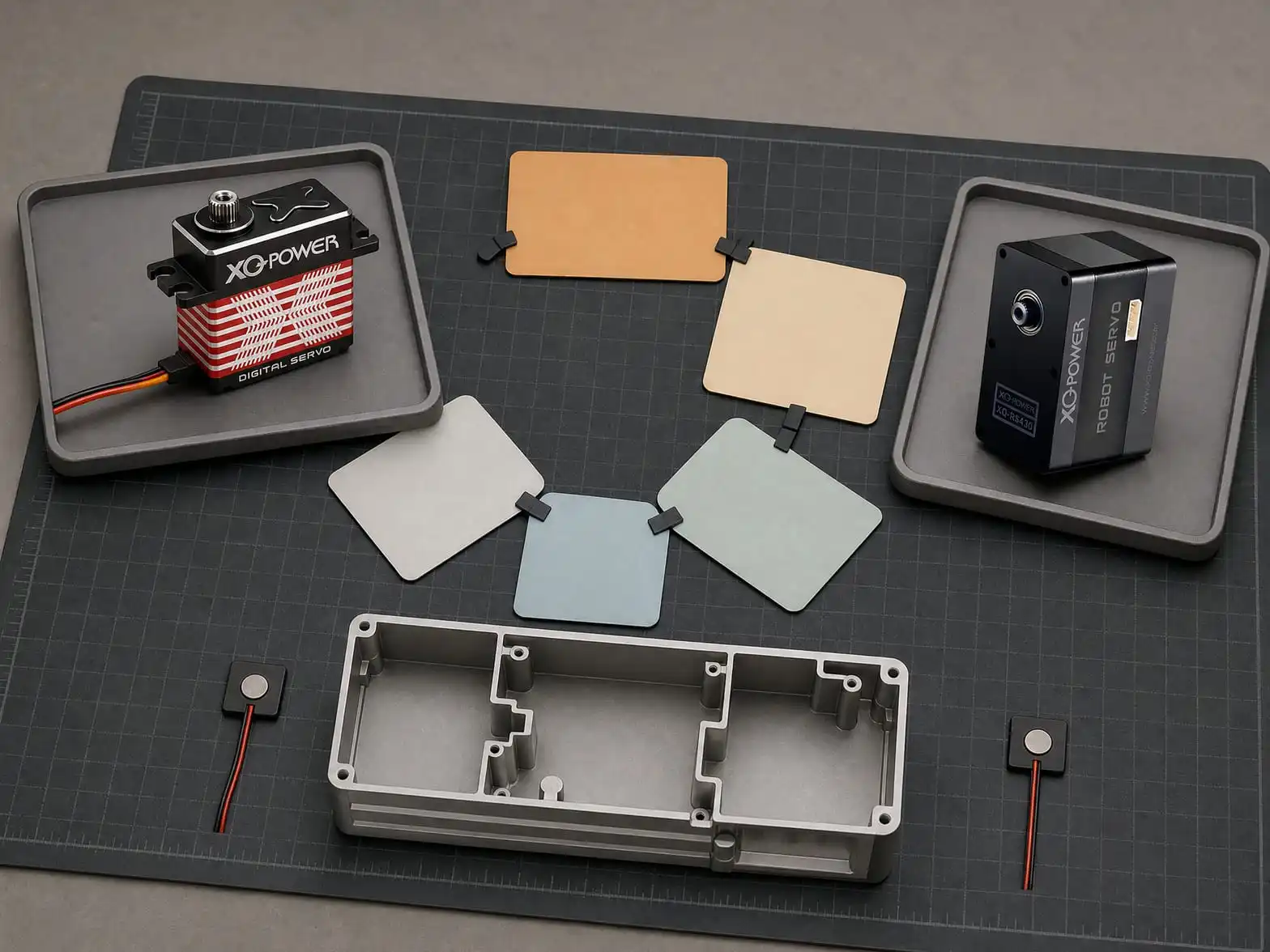
How mounting affects heat dissipation
A metal housing may transfer heat into a bracket or mounting plate, but the result depends on contact area, flatness, fastener preload, interface material, airflow and neighboring temperatures. A sealed enclosure can restrict heat transfer. The RS460 page describes a full CNC aluminum case as a heat-radiating structure; the BLS8175D page describes a CNC aluminum case. These are model-specific references, not universal guarantees.
Record case contact surfaces and verify that the production bracket matches the prototype. Check enclosure volume, vents, airflow direction, other heat sources and cable routing. Moisture protection must be interpreted separately from thermal design.
What to measure during a thermal test
- Electrical: voltage close to the actuator, current during acceleration, travel, hold, reversal and included fault conditions.
- Temperature: ambient temperature, sensor type, location, attachment method, timing and stabilization trend. Case temperature may not equal the hottest internal component.
- Mechanical: position behavior, noise, jitter, response changes, output play and neutral shift.
Use the same method when comparing configurations. If temperature is still rising at the end of the planned test, record the trend instead of calling it stable.
Staged validation without overclaiming
- No-load baseline: find wiring errors, abnormal noise and unexpected current; this does not prove application capability.
- Representative mechanism: install final or near-final bracket, linkage, bearing support and cable routing; check binding and hard stops.
- Controlled load increase: add load in defined steps while observing voltage, current, temperature and mechanical behavior.
- Complete duty cycle: include acceleration, travel, holding, reversal and rest, plus simultaneous multi-actuator operation where applicable.
- Boundary statement: report exact model, variant, voltage, load, mounting, duty cycle, ambient, method and duration, and state what was not tested.
What BLS8175D and RS460 references can and cannot show
The BLS8175D reference describes a brushless servo, contactless magnetic encoder, stainless steel gears, CNC aluminum case and torque references across 6.0–8.4 V. The RS460 reference describes an integrated Modbus RS485 smart servo, full CNC aluminum case, dual industrial ball bearings, 8 mm output shaft and telemetry fields including position, temperature, speed, voltage and current. Such facts help form a test plan, but do not establish a universal continuous-temperature curve or continuous-torque rating.
Common mistakes
- Treating peak torque as continuous torque.
- Measuring only central power-supply temperature.
- Testing without the final bracket or enclosure.
- Calling an aluminum case a guaranteed heatsink.
- Using only a no-load run.
- Reporting one temperature without sensor method, ambient, mounting or time history.
Conclusion
Review servo heat dissipation as part of the complete load path and duty cycle. Evaluate acceleration, travel, holding, reversal, rest, actuator voltage, current behavior, mounting contact, airflow, ambient condition and measurement method. Technical questions can be sent through the XQ-POWER contact page: https://www.xqservo.com/contact-us/.
FAQ: Servo Heat Dissipation and Thermal Management
What is servo heat dissipation?
It is the movement of heat generated in the motor, drive electronics, bearings and gear train through the housing, mounting structure and surrounding environment. The result depends on model, load cycle, mounting, airflow and ambient condition.
Does a higher torque rating mean a servo runs hotter?
Not automatically. Temperature depends on current, duty cycle, holding time, motion profile, friction, voltage, mounting and environment.
Can peak stall torque be used as continuous torque?
No. It is a defined short-duration or locked-shaft reference. Continuous operation requires the actual holding load, motion profile and thermal test method.
Does an aluminum case guarantee better cooling?
No. Verify case contact, bracket, airflow, enclosure, ambient temperature and neighboring heat sources in the complete assembly.
How should duty cycle be calculated?
Describe acceleration, travel, holding, reversal and rest with time, load and control state. This creates a repeatable test description but does not establish a temperature limit by itself.
What should be measured?
Measure voltage near the servo, current during each phase, ambient and actuator/case temperature, mounting, load, duty cycle and mechanical behavior. Record sensor location and duration.
Can RS485 or telemetry eliminate thermal testing?
No. Telemetry may provide useful temperature, voltage, current or position feedback when supported by the exact product, but it does not replace final-assembly testing.
Does a no-load test prove continuous-load capability?
No. Add the representative mechanism and load in controlled stages.
Is a splash-proof servo suitable for a hot enclosed mechanism?
Not automatically. Moisture protection and thermal performance are separate questions.
What information should be sent for a thermal review?
Provide exact model and variant, voltage, torque and speed, holding time, motion profile, duty cycle, bracket or enclosure, ambient, cable arrangement, load path and measurement method.
Official sources
- XQ-POWER Technical Guide
- XQ-POWER BLS8175D 75kg Brushless Servo
- XQ-POWER RS460 Modbus RS485 Smart Robot Servo
- Feiyida XQ-POWER SERVO category
- Feiyida UAV SERVO category
- XQ-POWER contact page
These sources provide product identity and engineering context, not universal thermal approval. Preserve page date, datasheet revision, SKU, measured values and final-application limits separately.
Fact boundaries and verification notes
- The Technical Guide identifies thermal management under real loads as an engineering topic.
- RS460 and BLS8175D descriptions are model-specific product references.
- A metal housing or bracket may contribute to a thermal path, conditionally on contact, airflow, ambient and geometry.
- Telemetry can support monitoring when available and correctly integrated, but does not replace complete-application measurement.
- Peak or stall torque is not a universal continuous-torque specification.
Excluded claims: no universal heat-transfer coefficient, temperature limit, continuous torque, current limit, efficiency, lifetime, IP67/IP68 system rating, chemical compatibility, flight performance, payload capacity, certification or production guarantee is claimed.
Keywords:
Related news
How to Operate UAVs in Rain, Dust, Heat, and Chemical Exposure
How to Select a UAV Flight Controller for Multirotor and VTOL Applications
How to Verify a Servo Mechanical Interface Before Installation
FYD-D4010L Agricultural Sprayer Drone Specifications: How to Read the Product Page
Industrial Servo OEM/ODM Specification Checklist for UAV, Robotics and Automation
Consult Immediately
If you are interested in our products, please leave your email and we will contact you as soon as possible. Thank you!



Company Address: 1 Bldg,Tonghe Industrial park,N26.Fuping Road,Longgang District Shenzhen City ,Guangdong Province,China.


© 2024~ Shenzhen XQ-POWER Technology Co., LTD. All rights reserved.